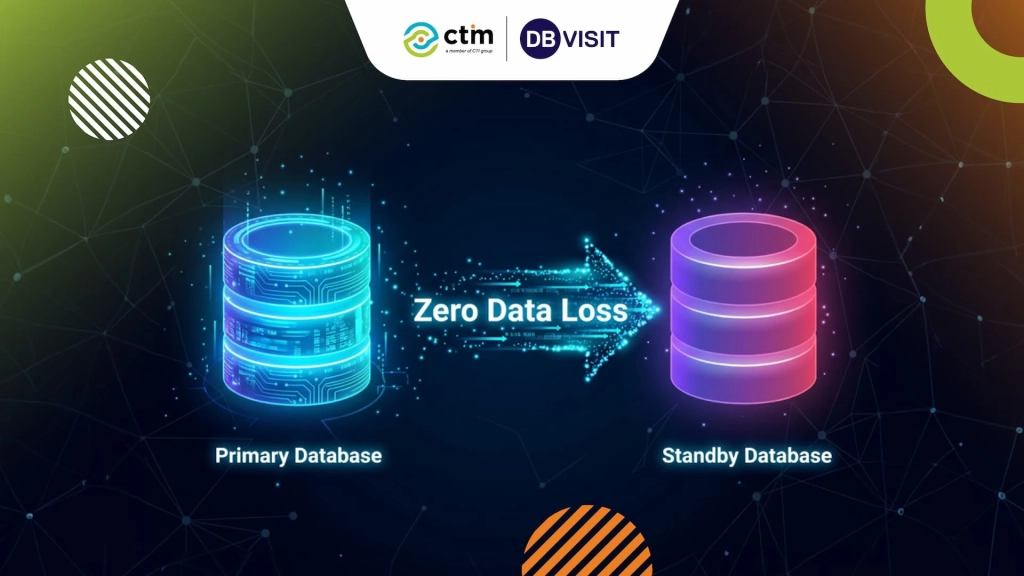
A standby database is essential to disaster recovery, but it does not guarantee that the latest transactions will be available after a failure. When database changes are replicated at intervals, a gap can remain between the primary and standby databases. If the primary fails before recent changes are transferred, those transactions may not be recoverable.
For businesses that depend on accurate, up-to-date data, even a few minutes of data loss can disrupt operations and create costly reconciliation work. Closing the data gap in a disaster recovery plan requires an appropriate replication strategy, a clearly defined Recovery Point Objective (RPO), and a recovery process that protects critical transactions.
Key Takeaways:
- Archive log shipping can create data gaps when delays in transferring archive logs leave recent transactions unprotected during disaster recovery.
- Real-time redo streaming helps minimize data loss by continuously transferring redo data and reducing potential data loss to less than one second in supported configurations.
- RPO and RTO address different recovery objectives by defining how much data loss is acceptable and how quickly systems must be restored.
- Strengthen Oracle Standard Edition DR without an upgrade by adding another layer of data protection without requiring an upgrade solely to access this capability.
1. Identify the Data Gap Between Your Primary and Standby Databases
The first step is to understand how your current replication method works and how much data could be lost if the primary database becomes unavailable.
Understand How Archive Log Shipping Works
Traditional archive log shipping transfers completed archive logs from a primary database to a standby database, where they are applied to keep the standby updated.
However, recent transactions are not available for standby recovery until their corresponding redo has been archived and transferred. This creates a gap between the latest committed transactions on the primary and the last archive log available on the standby.
Depending on the configuration and database activity, this gap can last several minutes. If a failure occurs during that window, recent transactions may be lost during recovery.
Calculate Your Recovery Point Objective (RPO)
RPO defines the maximum amount of data an organization can afford to lose, measured in time.
For example, a five-minute RPO means the business must be able to recover data to a point no more than five minutes before a disruption. The acceptable RPO depends on transaction volumes, business priorities, and compliance requirements.
Systems handling frequent financial transactions may require a lower RPO than applications with less time-sensitive data. Reviewing these needs helps determine whether the current replication setup provides sufficient protection.
Assess the Business Impact of Data Loss
Missing payment records, order updates, or inventory changes can lead to financial discrepancies, interrupted operations, and inconsistent records. Teams may also need to manually reconstruct missing transactions, adding time and complexity to recovery.
These consequences help determine whether the current data-loss exposure is acceptable or whether the disaster recovery strategy needs improvement.
Also Read: How Backup & Recovery Protects Your Business
2. Resolve the Archive Gap in Your Standby Database with Continuous Redo Streaming
Once the recovery gap is identified, organizations can look at ways to reduce the time between changes being generated on the primary database and becoming available for standby recovery.
Reduce Data Loss with Dbvisit StandbyMP Zero Data Loss
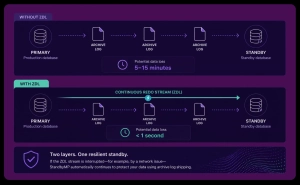
Dbvisit StandbyMP Zero Data Loss (ZDL) addresses the limitations of interval-based archive log shipping by adding continuous redo streaming.
Instead of waiting for an online redo log to be archived, ZDL continuously synchronizes active redo from the primary database to the standby server. This data is stored separately and can be used during standby activation to recover beyond the last available archive log.
In supported and suitably configured environments, ZDL can reduce potential data-loss exposure to less than one second, helping organizations protect recent transactions without relying solely on archive log transfer intervals.
Maintain Protection with Two Complementary Replication Layers
ZDL complements rather than replaces archive log shipping. Both methods work alongside each other:
Archive log shipping transfers and applies completed archive logs to maintain the standby database.
Continuous redo streaming synchronizes active redo, providing additional recovery data during standby activation.
This dual-layer approach combines established archive log replication with an additional recovery source. If redo streaming is interrupted, archive log shipping remains an independent replication path, although ZDL protection may be reduced until streaming is restored.
Align Your Recovery Point with Business Requirements
A lower RPO is especially valuable for workloads where missing transactions can have significant business consequences.
By reducing potential data loss, organizations can better protect critical records and minimize manual data reconstruction after an outage. The goal is to match the recovery point to the business impact of losing recent data.

3. Strengthen Oracle Disaster Recovery Without an Enterprise Edition Upgrade
Improving database resilience does not always require upgrading to a more expensive Oracle edition.
Extend Sub-Second RPO Capabilities to Oracle Standard Edition
StandbyMP ZDL brings sub-second RPO capabilities to support Oracle Standard Edition environments without requiring an upgrade to Enterprise Edition solely for this purpose.
This allows organizations to strengthen database protection while retaining their existing Oracle edition and licensing approach. ZDL is an optional, separately licensed StandbyMP feature, so its licensing requirements should also be considered.
Evaluate Your Existing Oracle Infrastructure
Before implementation, IT teams should assess their Oracle edition and configuration, network reliability, redo log storage performance, database workload, and recovery objectives. These factors help determine whether the environment is suitable for continuous redo streaming. Testing under representative workloads can also help validate infrastructure readiness
Also Read: How to Scale Up MySQL Database Capacity for Growing Workloads
4. Validate Your Disaster Recovery Plan Before an Outage Happens
Reducing data loss is only part of disaster recovery. Organizations must also ensure their standby database, and recovery procedures are ready when disruption occurs.
Test Your Recovery Process and Failover Readiness
Regular recovery testing helps verify standby database readiness, failover procedures, application dependencies, and team responsibilities. It also helps identify potential issues before an actual outage.
Review RPO and Recovery Time Objective (RTO) Together
RPO and RTO measure two different aspects of disaster recovery:
RPO: How much data can the business afford to lose?
RTO: How quickly must systems and services be restored?
A low RPO minimizes potential data loss, while an appropriate RTO ensures services return within the required timeframe. Both should reflect business priorities and be validated through regular recovery testing.
Close the Data Gap in Your Disaster Recovery Plan with Dbvisit StandbyMP ZDL Through CTM
Reducing data loss requires a replication strategy aligned with business recovery objectives and a recovery process that has been tested.
Dbvisit StandbyMP ZDL, available through Computrade Technology Malaysia (CTM), part of CTI Group, adds continuous redo streaming alongside archive log shipping to help achieve less than one-second data-loss exposure in supported Oracle Standard Edition environments.
By strengthening the recovery point without requiring an Enterprise Edition to upgrade solely for this capability, StandbyMP ZDL helps businesses protect critical database transactions and improve disaster recovery readiness.
Ready to close the data gap in your disaster recovery plan? Contact our team to asesst your Oracle infrastructure and explore whether Dbvisit StandbyMP ZDL align with your recovery objectives.
Author: Wilsa Azmalia Putri – Content Writer CTI Group