An enterprise AI workspace brings content creation, data analysis, research, and company knowledge into one managed environment. For Malaysian businesses, that means helping employees use AI across departments while giving the organization clearer oversight of its data and workflows. That gives everyday AI use a place in a coordinated business strategy.
Yet employee adoption and organizational direction aren’t always in sync. According to Microsoft’s 2026 Work Trend Index, which surveyed 2,000 Malaysian knowledge workers, only 32% of AI users said their leadership was clearly and consistently aligned on AI. Employees are moving ahead, but their organizations aren’t always keeping pace.
That gap plays out in everyday decisions, from which AI tools employees choose to how they use company information. Making AI dependable starts with understanding the risks behind routine tasks.
—
Key Takeaways:
- A secure AI workspace helps reduce shadow AI risks by bringing sensitive data and employee AI use under clearer oversight.
- Trusted company sources, guardrails, and human review help teams improve productivity without sacrificing decision quality.
- Bahasa Malaysia support and flexible AI models help businesses meet local needs while managing costs and vendor dependence.
—
How Can a Secure AI Workspace Reduce Shadow AI Risks?
Imagine an employee pasting a customer contract into a public chatbot for a quick summary. The job gets done, but the company may have no say in how that document is handled. That’s shadow AI, when employees use AI outside approved organizational controls.
Bringing it under control means addressing both the information people share and the protections built into the tools they use. Here’s where to start.
Keep Sensitive Information from Leaving the Business
Customer records, contracts, and product plans shouldn’t become unrestricted AI inputs. Sharing them through unmanaged services can expose confidential information or intellectual property. If personal data is involved, Malaysia’s Personal Data Protection Act (PDPA) may also apply.
Clear usage policies, data classification, and approved AI services help teams understand what they can share and when additional review is needed. That preserves productivity without making protection optional.
Build Data Privacy into the AI Environment
Policies work better when the technology supports them. Dedicated infrastructure, isolated databases, and encrypted storage help establish boundaries around company information. Data residency capabilities can also help organizations keep data within specified geographic locations.
A zero-training policy prevents enterprise data from being used to train base models. None of these safeguards guarantees compliance, but together they give IT teams stronger oversight of how AI processes business information.
Protecting the data is one part of the equation. The next is trusting the answers AI produces from it.
Also Read: AI Agents Are Scaling in Malaysia, Is Your Database Ready?
How Can an AI Workspace Build Trust in Business Decisions?
AI can deliver answers in seconds. But speed means nothing if the information is wrong. For executives, trust comes down to two things: teams making better decisions and AI delivering reliable outputs.
Here’s how businesses can get both right.
Improve Cross-Team Productivity and Decision Accuracy
HR can draft policies, legal teams can review contracts, marketing can develop campaigns, and finance can explore trends. A shared AI workspace helps these departments work within a consistent environment instead of relying on disconnected applications.
But the best AI workspace for teams must do more than save time. Leaders need visibility into information sources, defined responsibilities, and review checkpoints before AI-generated insights shape important decisions. That way, faster work doesn’t come at the expense of accountability.
Ground AI Responses in Trusted Sources and Guardrails
Retrieval-Augmented Generation (RAG) helps an AI model consult approved company information before responding. Ask about an internal policy, for instance, and the answer can draw from the actual document instead of general model knowledge alone.
Ground-truth alignment and pre- and post-generation guardrails add checks around that process. They help keep responses closer to trusted sources and filter inputs and outputs against set rules. Errors can still happen, which is why human review matters.
Even a well-supported answer, though, needs to make sense in the language employees and customers actually use.
Also Read: How to Build AI Agents That Don’t Go Rogue: Control, Safety, and Visibility for Malaysian Businesses
Why Does a Malaysian AI Workspace Need Local Context?
A model can write flawless English and still miss the nuances of Malaysian business communication. For enterprises working across languages, understanding local context is just as important as generating accurate responses.
Whether it’s connecting with customers or navigating Bahasa Malaysia documents, localized AI helps bridge that gap. Here’s where it makes a difference.
Make Customer Communication Feel Local
Marketing and customer-facing teams often move between English and Bahasa Malaysia. AI that recognizes local terms and context can help them research audiences and draft relevant messages, rather than relying on literal translations.
Teams should still review important communications for cultural fit, factual accuracy, and brand consistency.
Find Business Knowledge in Bahasa Malaysia
Embeddings help AI retrieve information based on meaning, not just exact words. Optimized Bahasa Malaysia embeddings can support searches across local contracts, policies, and internal records, even when an employee’s question uses different phrasing.

How Can Enterprises Scale AI Without Vendor Lock-In?
An AI setup that works for one team may not hold up as more departments come on board. As demand grows, so do the costs and risks of relying on a single AI provider.
To scale without getting locked in, enterprises need to look beyond upfront costs and keep their model options open. Here’s what to consider.
Measure the Full Cost of Enterprise AI
Total cost of ownership (TCO) covers compute, integration, security, maintenance, and training, not just subscriptions.
Flexible consumption models help align resources with demand, but savings depend on workload and implementation. Businesses should assess usage before expanding their AI footprint.
Keep Model Choices Open as Needs Change
A model suited to simple document summaries may not be ideal for complex analysis or multimodal tasks. Model-agnostic architecture lets organizations access different large language models (LLMs) and specialized options according to the job.
That flexibility can reduce dependence on a single provider and make it easier to evaluate newer capabilities without replacing the entire workspace.
How Does InWorks Bring Enterprise AI Together?
So, what features should an AI workspace include?
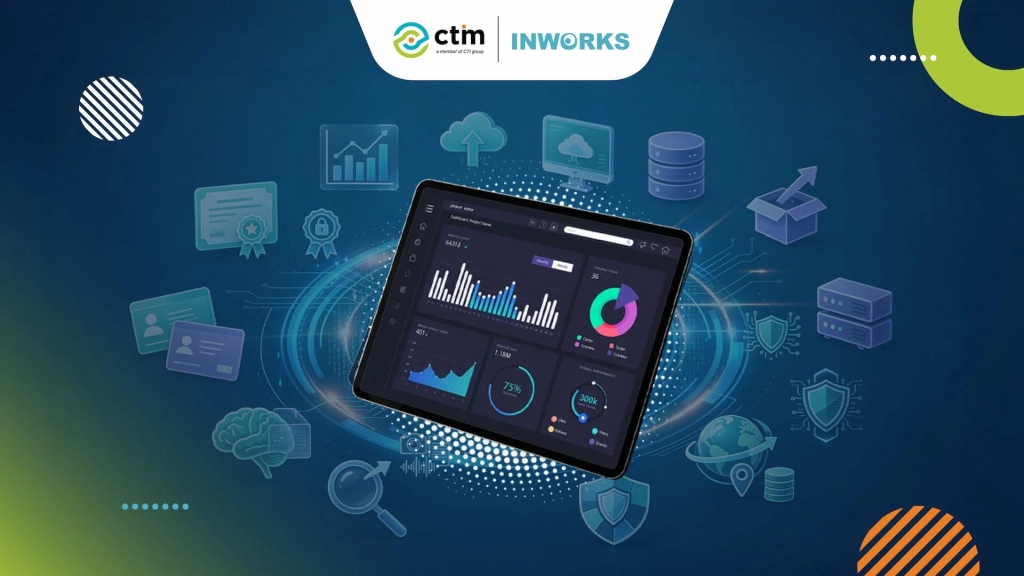
Beyond productivity, businesses need secure data handling, trustworthy knowledge retrieval, local-language support, and flexible model choices. InWorks, Computrade Technology Malaysia’s Enterprise AI Workspace powered by BytePlus, brings these priorities into one environment. Its Create Document, Create Media, Analytics, and Research & Brainstorm capabilities help teams draft, design, analyze, and explore business knowledge without constantly switching platforms.
For businesses comparing the best all in one AI workspace options, the real difference is how those capabilities work together. InWorks combines isolated databases, encrypted storage, data residency, and zero-training confidentiality with RAG, enterprise guardrails, Bahasa Malaysia-optimized retrieval, and model-agnostic access.
Together, they support AI adoption with greater control and room to grow.
Take AI Beyond Everyday Tasks
For Malaysian enterprises, the real value of AI goes beyond adding new tools. It’s about helping teams work smarter, make better decisions, and keep business data secure, all while staying ready for what’s next.
As part of CTI Group, Computrade Technology Malaysia (CTM) helps organizations turn technology investments into practical solutions that support their business goals.
Contact CTM today to discover how InWorks can help your business get more from AI with greater confidence and control.
Author: Danurdhara Suluh Prasasta
CTI Group Content Writer