Geopolitical uncertainty is often discussed in terms of trade, investment, energy prices, and physical supply chains. However, its impact increasingly extends to the digital infrastructure that businesses rely on every day.
Political tensions, conflicts, trade restrictions, and disruptions to global infrastructure can affect how organizations connect, access systems, exchange information, and work with partners across borders. Geopolitical risks can also disrupt trade flows, increase uncertainty, reduce investment, and create supply chain pressures beyond the countries directly involved.
For Malaysian organizations, this exposure is becoming increasingly relevant. Malaysia’s critical sectors are highly digitalized and depend on global infrastructure, including international connectivity, overseas technology providers, cloud ecosystems, and other external services. This creates potential points of vulnerability when disruptions occur beyond the country’s borders.
The result is a broader business continuity challenge: when external conditions become unpredictable, can your organization continue moving critical information securely and reliably?
How Geopolitical Uncertainty Creates New Digital Risks
Geopolitical instability can affect business operations in ways that are not immediately visible.
Disruption to shipping routes can delay physical goods. Trade restrictions can affect suppliers and production. Similarly, disruptions to connectivity, cloud services, data centers, or technology providers can affect how information moves between employees, customers, suppliers, and business partners.
Malaysia’s dependence on international digital infrastructure makes this an important consideration. The Khazanah Research Institute (KRI) notes that international subsea cables carry most of the global internet traffic, while Malaysia also relies on external infrastructure such as foreign transit providers, overseas data centers, and global technology services.
Cyber risk can also intensify during geopolitical conflicts. KRI highlights that previous conflicts have been accompanied by increased hacktivism and that cyberattacks can become a relatively accessible tool for geopolitical actors and other threat groups.
For enterprises, this means digital resilience must extend beyond network availability. The ability to securely access, exchange, and govern critical information is also part of maintaining operations during disruption.
Why Traditional File Sharing Is No Longer Enough
Many organizations still rely on email attachments, USB drives, public cloud links, or fragmented file transfer processes to exchange business-critical information.
While these methods may be convenient, they can make it difficult to maintain consistent control over who can access a file, how long access remains available, whether it has been downloaded, and what happens after it is shared.
For business leaders, the issue is therefore not simply how to transfer a file, but how to maintain visibility, control, and accountability throughout its lifecycle.
A more resilient file-sharing environment should provide centralized governance, identity-based access controls, encryption, activity monitoring, malware protection, and auditability. These capabilities become particularly important when sensitive information is exchanged across teams, business units, suppliers, customers, and other external parties.
Also Read: How to Send Large Files Fast & Securely Without Email Limits!
Building Digital Resilience with Secure Managed File Transfer
Centralizing File Transfers Across Teams and Partners
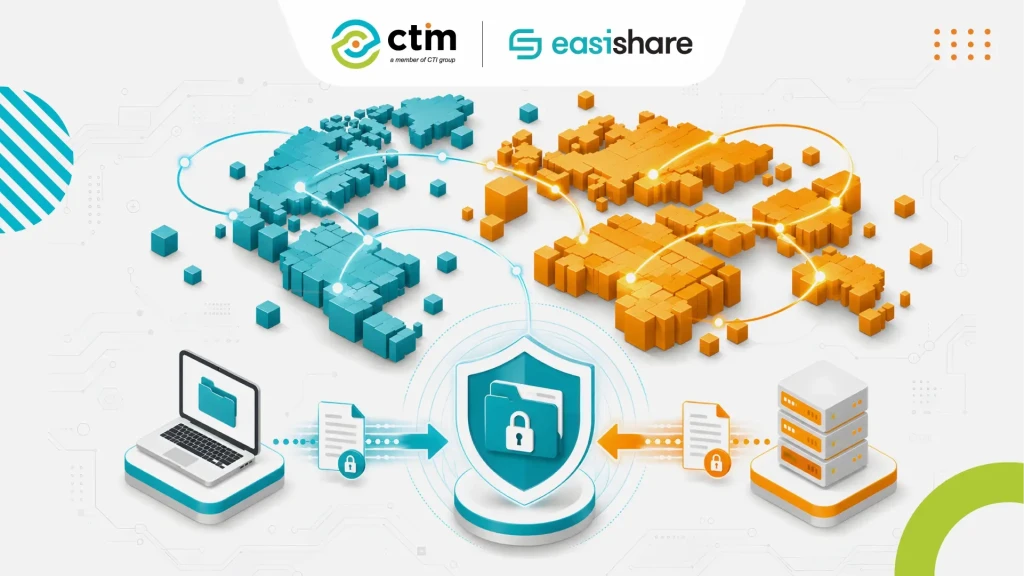
Managed File Transfer (MFT) provides a centralized environment for managing business-critical file exchanges while applying consistent security and governance policies.
Instead of relying on individual employees to determine how sensitive information should be shared, organizations can establish standard controls for internal teams and external partners. Granular access policies, secure links, expiry settings, download restrictions, authentication, and approval of workflows can help ensure that information reaches the intended recipient with appropriate controls in place.
This also gives IT and security teams greater visibility into how files move across the organization and its partner ecosystem.
Protecting Sensitive Business Information
Digital resilience also depends on protecting information while it is transferred, accessed, and stored.
Encryption can help protect data in transit and at rest, while multi-factor authentication and granular access policies can limit access to authorized users. Additional measures such as file-type restrictions, watermarking, view-only access, malware scanning, and content disarm, and reconstruction (CDR) can provide further protection against accidental exposure and malicious content.
A layered approach is particularly important when employees and external partners need to exchange sensitive contracts, financial information, customer data, engineering files, or intellectual property.
Supporting Business Continuity During Unexpected Disruptions
Resilience is not only about preventing security incidents. Organizations also need to understand their critical functions, external dependencies, and potential single points of failure, and establish appropriate measures to maintain essential operations during disruption.
KRI’s analysis of Malaysia’s financial sector highlights the importance of identifying critical functions, understanding internal and external dependencies, establishing recovery arrangements, avoiding excessive reliance on a single provider or system, and regularly testing resilience measures.
Secure file transfer does not replace broader business continuity planning. However, maintaining a controlled and reliable channel for critical information exchange can support essential collaboration when normal processes or communication methods are disrupted.
Also Read: 5 Causes of Data Breaches in File Transfer Malaysian Businesses Can’t Afford to Ignore
How EasiShare Helps Malaysian Organizations Strengthen Resilience
Once secure managed file transfer is established as part of the broader digital resilience strategy, the next consideration is the technology supporting it.
EasiShare provides an enterprise file security platform designed to secure, manage, govern, and access files while maintaining control over how information moves across an organization. It supports on-premises, private cloud, and hybrid environments, allowing organizations to align deployment with their existing infrastructure and data requirements.
Enterprise-Grade Secure File Transfer
EasiShare provides security controls including encryption, two-factor authentication, secure sharing links, link expiry, download restrictions, granular policies, and workflow approvals. It also supports antivirus and Content Disarm & Reconstruction (CDR) scanning to help detect, sanities, and neutralize malicious content.
For organizations with more stringent security requirements, EasiShare also supports capabilities such as AES-256/TLS 1.3 encryption, IP allowlisting, API-based controls, and access revocation after file delivery.
Automation That Reduces Operational Risks
Manual file-handling processes can introduce inconsistency and human error, particularly when the same types of information are exchanged repeatedly.
EasiShare supports automated workflows, approval processes, and integrations that can standardize recurring file transfer activities and security controls. This enables organizations to reduce reliance on manual intervention while maintaining consistent governance across business processes.
Audit Trails and Compliance-Ready Reporting
Resilience also requires visibility into how sensitive information is handled. EasiShare provides detailed audit logs covering file activities such as access attempts and downloads. These records can support monitoring, accountability, compliance reviews, and investigations when required, giving IT, security, and compliance teams greater visibility into file activity.
Prepare Your Business for Tomorrow’s Uncertainty
Geopolitical instability cannot be controlled by individual organizations. However, businesses can reduce their operational impact by understanding their dependencies and strengthening the systems that support critical activities.
For Malaysian organizations operating across teams, locations, partners, and jurisdictions, digital resilience should include the ability to secure, control, monitor, and maintain the flow of critical information, even when external conditions change unexpectedly.
A resilient digital environment is not about eliminating every external dependency. It is about identifying where those dependencies exist, reducing unnecessary points of failure, and maintaining sufficient control over critical data and processes.

Strengthen Digital Resilience with CTM and EasiShare
Computrade Technology Malaysia (CTM), part of CTI Group, works with organizations to strengthen their digital infrastructure with solutions designed around security, resilience, and business continuity.
Together with EasiShare, CTM can help Malaysian organizations establish a more secure and controlled approach to file transfer and collaboration, protecting sensitive information while maintaining the operational flexibility required in today’s increasingly interconnected business environment.
Talk to our team to explore how EasiShare can help strengthen your organization’s digital resilience.
Author: Wilsa Azmalia Putri
Content Writer CTI Group